🎯 500+ Traders earning profits with our strategies •🔥 Limited Time: Free Bonuses Worth ₹45,000+Stay tuned for new batch updates onInstagram!
🎯 500+ earning profits •🔥 ₹45,000+ Bonuses!Follow us onfor batch updates.
🎯 500+ Traders earning profits with our strategies •🔥 Limited Time: Free Bonuses Worth ₹45,000+Stay tuned for new batch updates onInstagram!
🎯 500+ earning profits •🔥 ₹45,000+ Bonuses!Follow us onfor batch updates.
Discover the fascinating journey from medieval marketplaces to modern digital exchanges. Learn how the simple concept of shared ownership evolved into the global financial system that shapes our world today.
Have you ever heard the saying, "Money makes money"? That's the magic of compounding.
The stock market may sound complex, but at its heart it is simply a place where people buy and sell shares of companies. A share means you own a small part of a company. Over time, this idea of sharing ownership developed into what we now call the stock market.
In this article, we'll take a simple journey through history to see how it all began.
Hundreds of years ago, long before digital trading, merchants met in busy marketplaces to exchange goods and services. One of the oldest known gathering spots for traders was the Bourse at Bruges in Belgium around the 1200s.
As trade expanded, some businesses grew too large for one person to fund. To raise more money, business owners began selling shares—small pieces of ownership—to many people.
A famous example is the Dutch East India Company, which sold shares to the public in the early 1600s to fund overseas voyages. This idea of shared ownership marked the birth of the stock market.
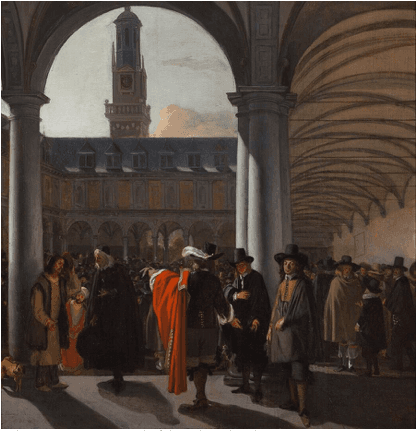

17th century artwork depicting the early days of stock exchange trading
As trading became more common, investors needed organised places to buy and sell shares.
📍 In many cities, people met under trees, in coffee houses, or at street corners to trade.
🏛️ Over time, these informal gatherings turned into proper organisations called stock exchanges.
In India, brokers gathered under a banyan tree near the Town Hall of Bombay in the 1850s.
This group later formed the Bombay Stock Exchange (BSE) in 1875 — one of Asia's oldest stock markets.
The stock market became a vital part of modern economies for several reasons:
Companies could get money from many investors instead of a few rich individuals.
Many people could share both profits and losses.
Investors could buy or sell shares when they needed cash.
Stock markets helped businesses expand and created jobs and wealth.
Here are some key moments in the evolution of stock markets:
The Dutch and British trading companies pioneered public share sales.
Formal exchanges like the London Stock Exchange and Bombay Stock Exchange were established.
Trading floors became busy, lively spaces where brokers shouted orders.
Computerised trading replaced paper and shouting.
Everything is digital, and investors can trade globally in seconds.
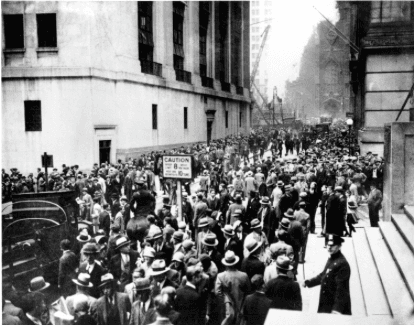
Historic photograph of crowds outside the New York Stock Exchange during the crash in 1929
Today's stock markets are global, digital, and highly regulated. You can trade online through apps or websites, and prices change instantly.
Rules and agencies — like SEBI (Securities and Exchange Board of India) — ensure fair play and protect investors.
Modern markets also reflect world events — a company's price can rise or fall based on global news, technology changes, or even political shifts.
Global
Digital
Regulated
Knowing how stock markets started helps us understand their purpose. They exist to connect people with ideas (companies) and people with money (investors). It's a system built on trust, transparency, and opportunity.
Even if you don't trade shares, stock markets influence the economy, job creation, and business innovation.
From traders in medieval Europe to digital platforms across the world, the journey of the stock market shows how human cooperation and innovation can build systems that benefit everyone.
Though times have changed, the main idea stays the same — businesses need capital, and investors seek growth.
The stock market is where those goals meet.